

The Cash Flow Gap Your P&L Isn't Built to Catch
Which part of your business is quietly bleeding money without you noticing? The stuff that looks fine on the surface but is actually a slow leak.
For one client, the leak was sitting in accounts receivable, invisible until someone tracked it.
The Gap
For this client, invoicing itself was never the problem. Every invoice went out accurately and on time, month after month, without exception.
What didn't exist was anything downstream of that: no reminder system to nudge a client who let a due date slip, no structured follow-up process, no late fee to make lateness cost something, and no one actually tracking what was outstanding against what should have already been collected. The business simply treated the gap between sending an invoice and collecting on it as background noise rather than something to manage.
That assumption held up fine on paper. Revenue was booked correctly and on schedule, exactly where it belonged in the accounting.
But the cash each invoice represented consistently showed up weeks after the invoice said it would, and because nothing was measuring that lag, it never registered as a problem worth solving. It just felt like the normal rhythm of running the business.
What We Installed
The fix here wasn't a new sales process or a pricing change. It was building the accounts receivable (A/R) infrastructure that should have existed from the start:
Automated reminders that go out the moment a due date is approaching or has passed
A structured past-due workflow so a late invoice triggers a defined next step instead of waiting for someone to notice
Late fee enforcement so lateness actually carries a cost
Ongoing monitoring that tracks what's genuinely outstanding, not just what has been invoiced
None of it required new tools the business didn't already have access to. It required someone to build the connective tissue between invoicing and collecting that had simply never been put in place.
What Changed
Average time to payment before: 45 days Average time to payment after: 28 days Improvement: 17 days of cash arriving when it was actually needed, not whenever a client got around to it.
What It Actually Revealed
The uncomfortable part of this finding is that the P&L was never going to catch it, by design. A profit and loss statement (P&L) records that an invoice was booked, full stop.
It has no mechanism for recording when the client actually paid it, so fifteen to thirty days of routine lag sat invisible inside numbers that were, by every other measure, accurate.
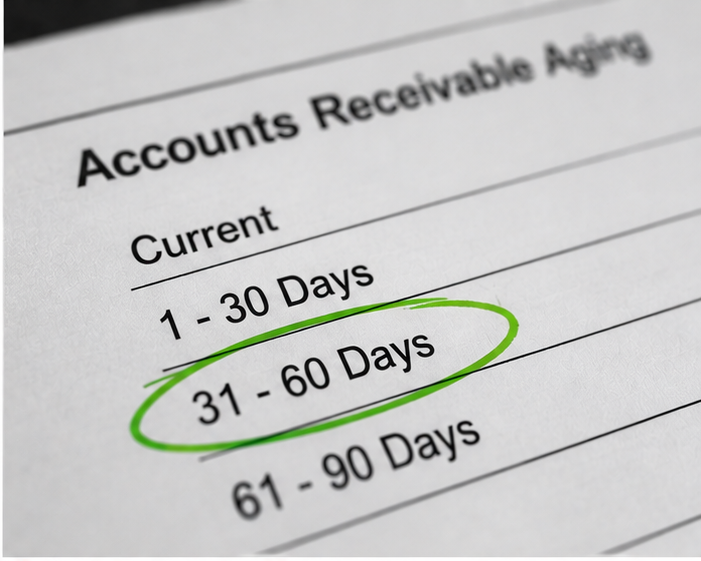
That doesn't mean the answer was unknowable. It was sitting in the accounts receivable aging report the entire time, a document built specifically to show what's outstanding and for how long.
But even that report only answers half the question. It shows that an invoice is 22 days late. It doesn't show what that lateness is doing to the bank balance right now, whether payroll clears on time, or what decision it's quietly forcing.
Someone still has to translate "this invoice is overdue" into "this is why Friday feels tight," and that translation step, not the report itself, is what wasn't happening here.
Cash doesn't lie. Revenue sometimes does, not because anyone is misrepresenting anything, but because revenue answers a different question than the one most owners think they're asking when they look at it.
And this business wasn't an outlier: 61% of small and mid-sized businesses have no clear, real-time view of their own cash position.
Most of them have a report somewhere that could tell them. What they don't have is the translation from that report to what it means for the decision sitting in front of them right now.

The Three-Driver Check
One driver rarely moves alone. Revenue, cash flow, and profit have to be reviewed together, and this result is proof why:
Driver 1: Revenue. The revenue number was accurate the entire time, booked correctly, on schedule.
Driver 2: Cash Flow Timing. 15 to 30 days of routine lag, invisible until someone tracked outstanding against expected, not just invoiced against paid.
Driver 3: Profit. A business can look profitable on paper and still come up short on the day payroll is due. That's the part a P&L was never built to warn you about.
This result lived in Driver 2, Cash Flow Timing.
But the same 17-day gap reached into the other two drivers as well, not by changing their numbers, but by changing what those numbers were actually worth in the moment.
Revenue was booked accurately. Profit was calculated accurately. Neither number was wrong. What the 17 days changed was whether that revenue and profit were sitting in the bank or still owed, and a number can be earned, correct, and completely unusable at the same time.
Three Questions Worth Asking Your Own Numbers
Do you know your actual average time to payment, or just your payment terms?
If your best client paid three weeks later than usual, would you notice before it affected a decision?
Does anything happen automatically when an invoice goes past due, or does it depend on someone remembering to follow up?
If any of those took a second too long to answer, that's worth three minutes of your time. The Revenue-Cash Disconnect Quiz tells you exactly which of the three drivers is costing you the most right now, before you spend another month guessing.
Take the Revenue-Cash Disconnect Quiz
