

This is one story from our work, with details changed to protect the client.
The Profit and Loss says the company made money.
Then the owner asks a harder question:
Which services are actually producing that profit?
The financials cannot answer it.
Revenue is recorded. Expenses are recorded. The company total is profitable.
But the reporting is not organized in a way that shows the revenue and cost of delivering each part of the business.
That changes what we can do with the numbers.
THE PROFITABILITY GAP
At the company level, the financials are doing their job. We can see total revenue, total costs, gross profit, and net profit.
What we cannot see is what happened underneath those totals.
One service may produce a stronger margin than another. Another may require more labor, contractor time, materials, discounts, or support than the price is covering. A high revenue service may contribute less profit than a smaller one.
One profitable part of the business may also be carrying another without anyone realizing it.
We cannot know which of those things is happening unless revenue and the costs connected to the work are recorded in a way that allows us to compare them.
That was the gap in this business.
The company was profitable. The service level economics were still invisible.
WHAT THE P&L SHOWED VS. WHAT WE STILL COULD NOT ANSWER
What the financials showed: The company was profitable overall.
What the revenue detail showed: Money was coming in from multiple services and offers.
What the reporting could not show: The cost and margin attached to each individual service.
What was missing: A supported way to connect revenue with the direct cost of delivering the work.
The decision gap: We could not reliably say which services were contributing the most profit, which were consuming more resources, or where pricing or delivery deserved a closer look.
A profitable company total answers an important question. It does not answer every profitability question inside the business.
WHAT IT ACTUALLY REVEALS
In the Richmond Fed’s latest regional service-sector survey, businesses reported average price increases of 6.12% for what they paid and 3.86% for what they charged over the past year. Those averages don’t tell us what happened to the margin on any one service. That still requires looking at what each service costs to deliver and what it contributes before deciding whether its price needs to change.
Revenue tells you what came in. It does not tell you what drove it, what it cost, or what you will keep.
To answer those questions, the reporting has to match the way the business actually operates.
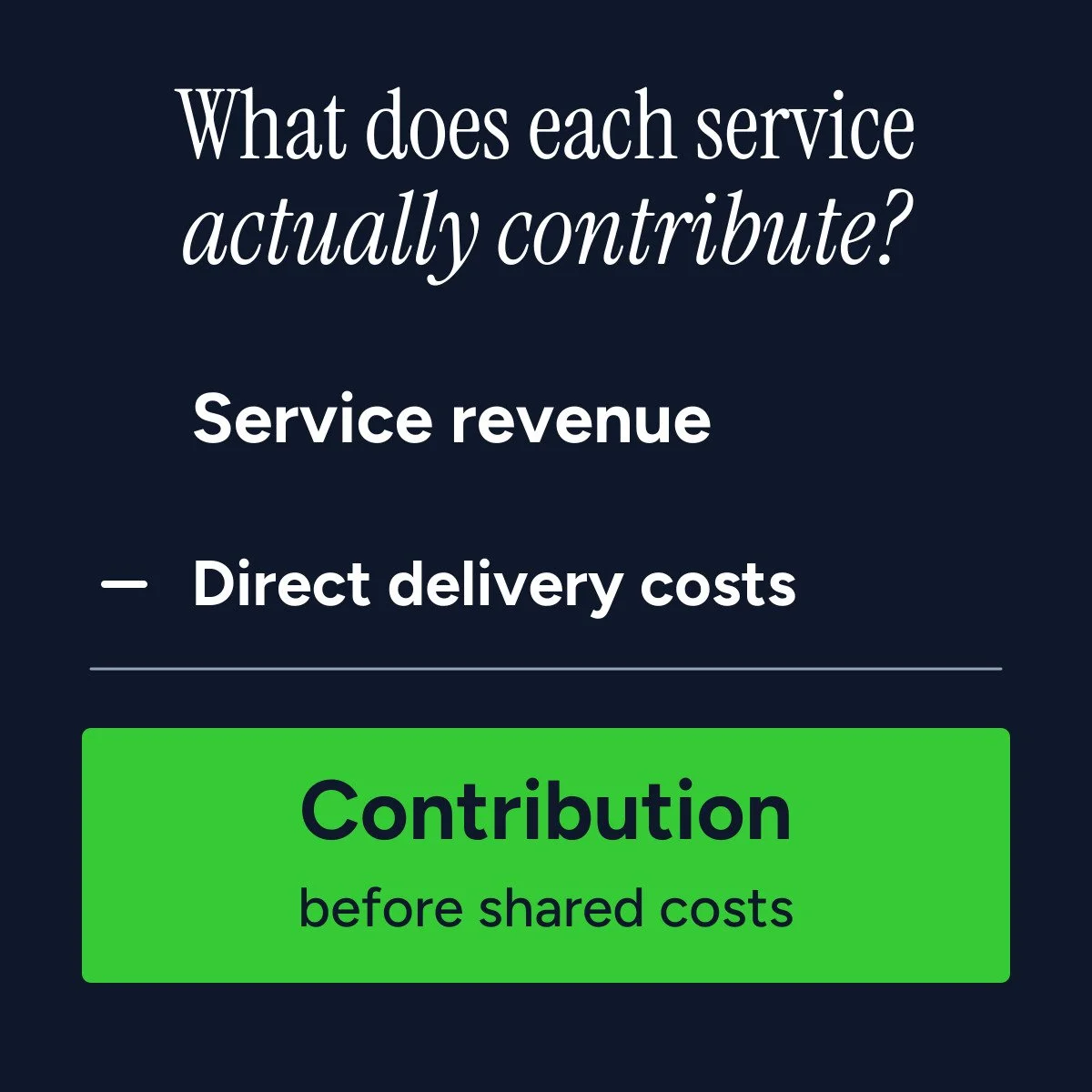
If we want to know whether one service is more profitable than another, we need more than total revenue and total expenses. We need to know which revenue belongs to each service and which direct costs can reasonably be connected to delivering it.
Shared expenses may stay at the company level or require a supported allocation. We do not need to force every dollar into a service category.
We need enough structure to answer the business question in front of us.
That is the next layer after getting the books current and accurate.
Are the numbers organized for the decision we are trying to make?

THE THREE DRIVER CHECK
One driver rarely moves alone. Revenue, cash flow, and profit have to be reviewed together.
Driver 1, Revenue: Which services, clients, projects, or offers are producing the revenue? Is the mix changing? Is growth coming from the work we actually want more of?
Driver 2, Cash Flow: How and when does each type of work turn into cash? Does one service require more labor, materials, contractor cost, or other investment before customer payments arrive?
Driver 3, Profit: After the direct cost of delivering the work, what does each service actually contribute? Are pricing, scope, labor, or delivery costs changing what the business keeps?
The home driver here is Profit.
The company was profitable. The unanswered question was where that profit was actually coming from.
That question reaches revenue and cash flow too, because the mix of work affects what comes in, what the business has to fund, and what remains.
THREE QUESTIONS WORTH ASKING YOUR OWN NUMBERS
Can we see revenue by the services, clients, projects, or other categories we actually make decisions about?
Can we connect the major direct costs of delivering that work to those same categories?
If one part of the business became less profitable this quarter, would our current reporting show us which one?
If you cannot answer those questions from your current reports, the company total may be accurate and still be too broad for the decision you need to make.
That matters before we change pricing, add capacity, put more marketing behind an offer, or discontinue something that appears less productive from the outside.
The whole business can be profitable while different parts of it are producing very different economics.
We need the reporting structured well enough to see the difference.
BUSINESS CLARITY CONVERSATION
If the company total looks healthy but you cannot tell what is happening underneath it, that is exactly the kind of question we can work through together.
In this complimentary 30 minute Business Clarity Conversation, we will talk through what has changed, what you are trying to understand or decide, and what your financials and other business information could help answer.
From there, we will work through practical first steps.
No financial reports required before we meet.
This is a focused conversation, not a financial audit or full business diagnostic.
Book a complimentary Business Clarity Conversation
SOURCE
FAQ
Can a company be profitable while one service is not?
Yes. Company level profit combines the economics of all services, clients, projects, and offers. One part of the business can produce a stronger margin while another uses more labor, materials, contractor support, or other delivery cost.
Why does a Profit and Loss not always show service profitability?
A standard company level Profit and Loss records the business total. If revenue and direct costs are not organized by the categories the owner needs to compare, the report may be accurate without showing profitability by service.
Do all expenses need to be assigned to individual services?
No. Direct costs should be connected where the relationship is supportable. Shared operating expenses may stay at the company level or use a reasonable allocation when that is useful for the decision.
What are decision ready financials?
Decision ready financials are current and accurate, with enough structure to answer the business question in front of the owner. The needed structure depends on the decision. It may include visibility by service, client, project, location, crew, or another meaningful operating category.
What is the Business Clarity Conversation?
The Business Clarity Conversation is a complimentary 30 minute conversation focused on what has changed, what you are trying to understand or decide, and what your financials and other business information could help answer. No financial reports are required before the meeting.